Why Your Business Is Invisible to ChatGPT and Google AI Search in 2026 — And How to Fix It
Share this article
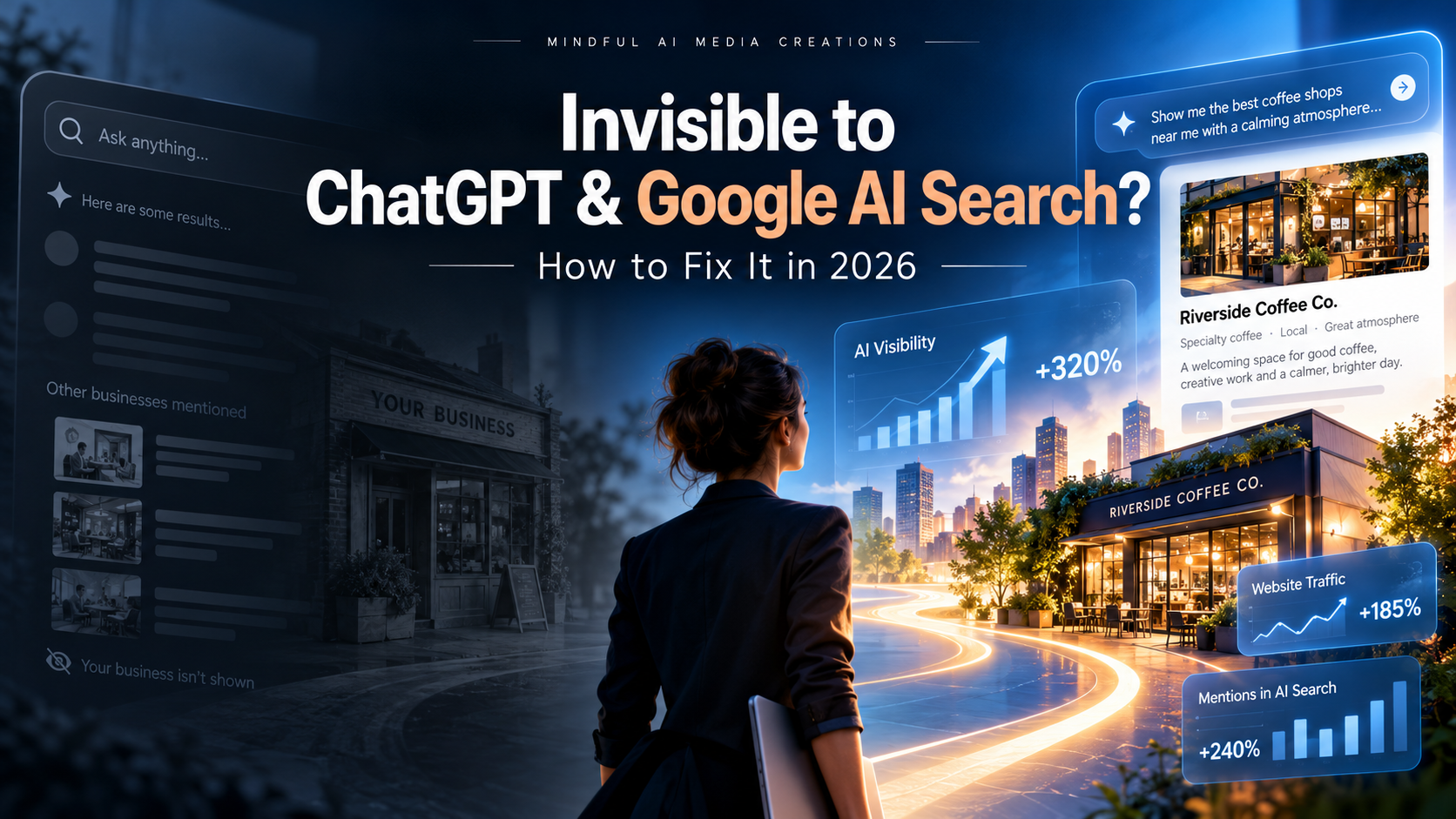
Why Your Business Is Invisible to ChatGPT and Google AI Search in 2026 — And How to Fix It
By Mindful AI Media Creations | October 9, 2026
Your website may look impressive. Your Google rankings may be respectable. Your business might even have five-star customer reviews. But when someone asks ChatGPT or Google AI Search to recommend a business like yours, does your name appear?
If the answer is no, you're facing an increasingly important digital marketing challenge.
Welcome to the age of AI search optimization for small businesses, where being online doesn't automatically mean being discovered.
Customers aren't just typing keywords into Google anymore. They're asking full questions, comparing providers, requesting recommendations, and using AI assistants to narrow their choices.
And for business owners, that changes the competition.
The question is no longer simply, "Does my website rank?"
It's also: "Can potential customers discover, understand, and trust my business through AI-powered search?"
Let's explore what is changing, why some businesses are overlooked, and seven practical ways to improve your visibility.
1. The Search Engine Revolution Is Already Here
For years, traditional search engine optimization (SEO) focused on helping websites appear prominently in Google results.
Businesses invested in keywords, backlinks, content, and technical website improvements.
Those fundamentals still matter.
But search experiences are evolving.
Google now offers AI Overviews and AI Mode, allowing people to ask detailed questions and receive generated answers with supporting web links.
ChatGPT and other AI assistants also provide conversational ways to research businesses, products, and services.
Consider how customers search.
Traditional search:
"Brooklyn digital marketing agency"
Conversational AI search:
"Which digital marketing agencies in Brooklyn can help a small business improve Google rankings, AI search visibility, and lead generation?"
That second search communicates more about the customer's actual problem.
It also creates an opportunity for businesses that clearly explain their services, demonstrate relevant experience, and publish helpful information.
According to Google's August 2026 update, AI Overviews had surpassed 2.5 billion monthly active users, while AI Mode had exceeded one billion.
The takeaway is simple: AI-assisted discovery has become too significant for business owners to ignore.
2. The Zero-Click Problem: Why Visibility Doesn't Always Produce Website Traffic
Here's one of the most important changes in digital marketing.
People can now receive useful information directly from search results without visiting another website.
This behavior is commonly called zero-click search.
In July 2025, Pew Research Center published an analysis of Google search behavior involving 900 U.S. adults and nearly 69,000 unique searches.
Its findings deserve attention:
When a Google AI summary appeared, users clicked a traditional search result during 8% of visits.
Without an AI summary, traditional results received clicks during 15% of visits.
Links inside AI summaries received clicks during only 1% of visits featuring those summaries.
These figures describe observed search behavior, not proof that AI summaries caused every lost click.
Google has also reported that overall organic search clicks remained relatively stable and that the quality of those clicks improved.
Source: Google Search, August 2025
Both findings can be relevant: search behavior is changing, but the effects differ across websites, industries, and individual searches.
What this means for your business: Counting website visitors is no longer enough.
You should also measure qualified inquiries, appointments, phone calls, branded searches, leads, and sales.
Ten visitors who seriously need your services can be worth more than a hundred visitors who leave without taking action.
3. Why Your Business May Be Missing From AI Search Recommendations
Imagine two businesses offering similar services in the same neighborhood.
Business A has a beautiful website filled with broad claims like:
"We deliver innovative, cutting-edge solutions for all your business needs."
Business B explains its work in plain language:
"We help Brooklyn small businesses improve local Google visibility, create conversion-focused websites, and turn online searches into customer inquiries."
Which description gives a search system more specific information about the company's services and customers?
Business B.
That doesn't guarantee it will be recommended. AI recommendations depend on many factors, and different search systems work differently.
But vague descriptions make it harder for people—and potentially search systems—to understand a business.
Common visibility weaknesses include:
Unclear service descriptions. Your website doesn't explain exactly what you do, who you serve, and where you operate.
Inconsistent business information. Your company name, address, contact details, or services differ across online profiles.
Thin or repetitive content. Your blog repeats generic advice instead of addressing real customer problems.
Technical website problems. Important pages may be inaccessible, difficult to navigate, or poorly structured.
Limited independent credibility. Your business has few relevant reviews, references, case studies, or trustworthy mentions.
Poor conversion design. People find your website but don't know what to do next.
These are weaknesses worth correcting whether your immediate goal is stronger Google rankings, AI search visibility, or more qualified leads.
4. SEO, AEO, and GEO: What's the Difference?
Three terms appear frequently in digital marketing conversations.
SEO — Search Engine Optimization
SEO helps search engines discover, understand, and rank relevant website pages.
It includes technical improvements, keyword research, helpful content, internal linking, and website usability.
AEO — Answer Engine Optimization
AEO focuses on making content useful for answering specific questions.
For example:
"How much does local SEO cost for a small business?"
A useful page might explain common pricing models, services included, factors affecting cost, and questions to ask before hiring a provider.
GEO — Generative Engine Optimization
GEO is an emerging term for strategies intended to improve how brands and content are discovered, represented, or referenced in generative AI experiences.
This may involve clearer business information, original research, trustworthy content, and a credible presence beyond your own website.
Here's the important distinction: SEO, AEO, and GEO are not three magical switches.
Google explicitly states that its standard SEO best practices remain relevant for generative AI features. It also says there are no special technical requirements for inclusion in AI Overviews or AI Mode beyond the applicable Search requirements.
Source: Google Search Central — AI Optimization Guide
At Mindful AI Media Creations, we believe these disciplines work best as a coordinated visibility strategy—not as competing marketing buzzwords.
5. Seven Practical Ways to Improve Your AI Search Visibility
You don't need to rebuild your entire website tomorrow.
Start with the fundamentals, prioritize the biggest weaknesses, and measure the results.
Step 1: Make your business identity unmistakably clear
Visit your homepage and ask yourself:
Can a new visitor understand what we do within five seconds?
Your homepage should clearly communicate your services, target customers, geographic area when relevant, and the next step to take.
Replace generic phrases with specific descriptions.
Instead of:
"We provide innovative solutions."
Try:
"We help independent pet care businesses attract local customers through website optimization, content marketing, and lead generation."
Clear descriptions also make your website more useful to conventional search engines.
Step 2: Publish content that answers real customer questions
Your next blog post should solve a problem—not simply fill space.
A dog grooming business could publish:
"How Often Should a Long-Haired Dog Be Professionally Groomed?"
A local accountant could publish:
"What Financial Records Should a New Small Business Keep?"
A marketing agency could explain:
"Why Isn't My Business Showing Up in Google Maps?"
These topics match questions potential customers might actually ask.
Use descriptive headings, accurate explanations, relevant examples, and concise answers.
Where possible, add firsthand experience or original information that competitors haven't published.
Step 3: Strengthen your local business presence
For businesses serving a defined geographic area, local SEO is particularly important.
Review your Google Business Profile and relevant business directories.
Keep your business name, contact information, operating hours, service categories, and location details accurate.
Make sure your website and external listings don't contradict one another.
Encourage genuine customer reviews without offering prohibited incentives or attempting to manipulate ratings.
A local pet groomer, for example, benefits from a clear service area, accurate booking information, and authentic customer feedback.
These improvements help customers evaluate the business and support a trustworthy local web presence.
Step 4: Build credibility beyond your website
Your website shouldn't be the only place people can learn about your business.
Credibility can grow through customer testimonials, relevant industry websites, community participation, useful guest articles, and genuine media coverage.
Reddit discussions can also provide valuable insight into the questions customers ask and the language they use.
But don't turn community participation into spam.
Contribute useful information first. Be transparent about your business connections and respect community rules.
Independent mentions and positive reviews can strengthen public trust, although no particular mention guarantees inclusion in an AI-generated answer.
Step 5: Fix technical SEO problems
Even excellent writing can underperform if search engines struggle to access your website.
Check that important pages are indexable, navigation works correctly, mobile layouts display properly, and pages load efficiently.
Use descriptive page titles, logical heading structures, relevant internal links, and accessible images with meaningful alternative text.
Structured data can also help eligible search systems understand supported information about your business, articles, and services.
However, schema markup is not a secret shortcut to ChatGPT recommendations or Google AI citations.
The goal is to make your website technically sound, understandable, and useful.
Step 6: Demonstrate real expertise
Generic AI-generated articles are easy to produce.
Distinctive experience is harder to replicate.
A professional dog trainer can explain a real training challenge and the approach used to address it.
A marketing consultant can share an anonymized website audit showing the problems discovered and the recommendations made.
A local contractor can document a completed project with photographs, materials, and practical lessons.
Make your content more valuable by including genuine expertise, named authors when appropriate, dated updates, credible references, and honest limitations.
Google's guidance emphasizes original, helpful material rather than content created primarily to manipulate rankings.
Source: Google Search Central, May 2026
Step 7: Turn increased visibility into actual customers
Getting discovered is only the beginning.
Once a visitor arrives, your website should guide them toward a meaningful action.
That might be requesting an assessment, scheduling a consultation, asking for a quote, or joining a useful email newsletter.
Make your primary call to action clear.
Keep forms simple, explain what happens after submission, and give people a reason to trust your business.
For example, a visitor searching for help with local SEO may be more likely to request a focused visibility review than to complete a vague "Contact Us" form.
Your marketing should connect three stages:
Get discovered. Build trust. Generate inquiries.
That's how visibility becomes a business asset rather than another impressive dashboard number.
6. A Practical Example: A Brooklyn Pet Grooming Business
Let's look at a hypothetical example.
A grooming business has a professional website, loyal customers, and a handful of online reviews.
But its homepage simply says:
"Welcome to our pet grooming salon. We love your pets!"
The site doesn't clearly identify its service area, explain grooming packages, or answer common customer questions.
A customer asks an AI search tool:
"Where can I find a dog groomer in Brooklyn who works with anxious dogs?"
The business may be relevant, but its website provides little evidence that it offers anxiety-sensitive grooming.
Now imagine the business improves its homepage, adds accurate service descriptions, publishes an educational article about grooming nervous dogs, and updates its local listings.
The website now gives customers—and search systems evaluating relevant web information—a clearer picture of what the company offers.
Will the business automatically appear in ChatGPT?
No.
But it has strengthened its online presence, improved its usefulness, and removed several obstacles to being discovered.
That is the kind of practical improvement businesses can control.
7. How to Measure Whether Your Strategy Is Working
AI visibility is not always easy to measure, and no single dashboard captures every discovery channel.
A practical monthly review should consider:
Organic search performance: impressions, clicks, important queries, and landing pages from Google Search Console.
Business inquiries: calls, completed forms, consultation requests, and appointments.
Conversions: how many inquiries become qualified leads or paying customers.
Local visibility: relevant Google Business Profile activity and listing accuracy.
AI discovery observations: whether your business appears in a repeatable sample of relevant AI-assisted searches.
Customer feedback: asking new customers how they discovered your business.
AI search recommendations can vary by prompt, location, personalization, available sources, and time.
For that reason, one successful ChatGPT test isn't proof of a lasting ranking improvement.
Track patterns over time, not isolated screenshots.
Above all, connect your visibility work to meaningful business outcomes.
8. Frequently Asked Questions About AI Search Optimization
How do I get my business to show up in ChatGPT?
Start by making your business easy to understand and discover online. Maintain accurate information, publish useful content, improve technical SEO, and build credible references. There is no guaranteed method for securing ChatGPT recommendations.
Is SEO still worth investing in during 2026?
Yes. Google's official guidance confirms that traditional SEO remains foundational to its generative AI search experiences. Businesses still benefit from accessible websites, relevant content, technical quality, and strong user experiences.
What is the difference between SEO and GEO?
SEO generally focuses on organic search discovery and performance. GEO focuses on how content and brands may be represented or referenced in generative AI systems. The two overlap considerably.
Can a small business compete with larger companies in AI search?
Small businesses can create highly relevant content for specific customers, services, and local areas. That can help them compete for focused discovery opportunities, although results depend on competition, source quality, and search-system behavior.
How long does AI search optimization take?
There is no universal timeline. Technical fixes may be completed quickly, while changes in indexing, discovery, citations, and lead generation can take longer. Measure progress regularly without promising guaranteed placement.
Should I stop doing traditional SEO and focus only on AI?
No. A coordinated approach is more sensible. Strong traditional SEO supports website accessibility and discoverability, while useful answers, original expertise, and clear business information support broader discovery.
9. The Bottom Line: The Future of Search Rewards Businesses That Are Easy to Understand and Trust
The way customers discover businesses continues to evolve.
Search isn't disappearing. It's becoming more conversational, more detailed, and increasingly supported by artificial intelligence.
Business owners who focus exclusively on yesterday's keyword rankings risk overlooking how their customers research services today.
But chasing every new AI marketing trend is not the solution either.
A durable strategy starts with the basics: clear positioning, helpful content, strong technical SEO, trustworthy information, and an effective way to convert visitors into customers.
Your website shouldn't just exist online. It should help the right customers find you, understand your value, and take action.
That's where a smarter visibility strategy begins.
Is Your Business Being Overlooked by AI Search?
You might have a great service, a strong reputation, and a website you're proud of.
But if customers struggle to discover you through Google, AI search, and local business searches, opportunities may be passing you by.
At Mindful AI Media Creations, we help businesses strengthen their online presence through search optimization, AI-focused content strategies, website improvements, and lead generation.
Our approach combines practical SEO, AEO, and GEO principles with conversion-focused digital marketing.
Ready to discover what's holding your visibility back?
Visit https://mindfulaimediacreations.info and request an AI Search Visibility Review.
We'll start by looking at how clearly your website communicates what you offer, how easily it can be discovered, and where improvements may help generate better inquiries.
Mindful AI Media Creations
Be Found. Build Trust. Turn Visibility Into Business.
Research & Further Reading
Pew Research Center — Google Users Are Less Likely to Click When an AI Summary Appears (July 2025)
Google Search Central — Optimizing Your Website for Generative AI Features (2026)
Google Search Central — A New Resource for Optimizing for Generative AI (May 2026)
Google — New Opportunities, Control and Insights for Website Owners (Updated August 2026)
Google — AI in Search Is Driving More Queries and Higher Quality Clicks (August 2025)